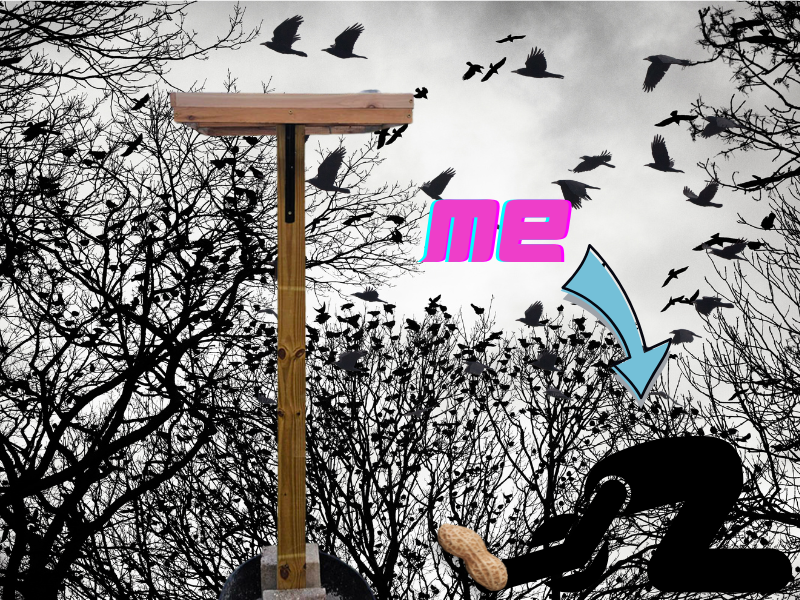
Since I was a young’un, I’ve been fascinated by crows, really corvids of all types. The first interest came when crows were always the friend of a witch or someone mystical, or that is what a vampire could turn into (usually a bat, but sometimes a crow). As I got older and did more research about crows, my fascination grew. Crows are incredibly intelligent with compelling social dynamics. They also recognize human faces and will spread to fellow crows and their offspring lore about you, good or bad. I also found out they will help protect my backyard chicken flock by chasing off pesky birds of prey like hawks.
In this post, I will discuss how I built my crow tower, how it’s currently going, and fun facts about crows!
Building a Crow Tower
Materials/Items Needed:
- 2″ Green or Tan Exterior Screws (aka deck screws; avoid zinc screws as they will start to rust and leave “bleeding” streaks)
- 3/4″ Brass Exterior Screws
- One 1″x2″x8′ unfinished cedar board and one 1″4″x8′ unfinished cedar board
- 4″x4″x8ft ground contact pressure-treated lumber
- 50 lbs bag fast-setting concrete mix (*see note below)
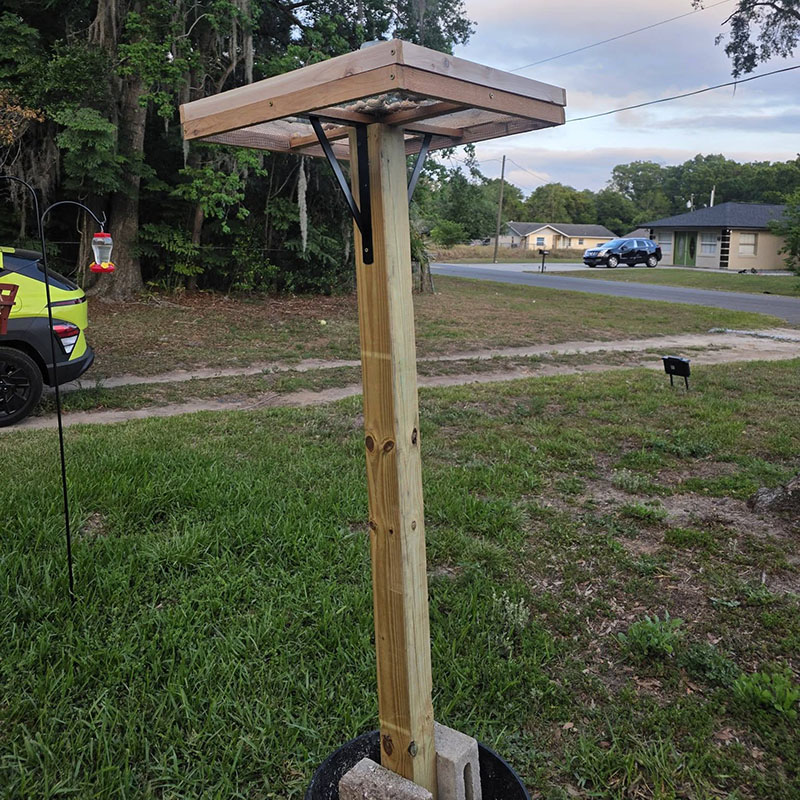
- Two 8″x12″ heavy-duty steel shelf brackets
- Better Homes & Gardens Whiskey Barrel Recycled Resin Planter (20″x20″x13″)
- Small concrete pavers, bricks, cinder blocks, large rocks, etc. (optional)
- Level (optional)
- 1/4″ hardware cloth
- Gloves
- Staple gun and heavy-duty staples
- Power drill
- Offset Aviation Snips OR Cutting pliers
- Saw (optional, sort of; Lowe’s will cut the wood you buy, but you will have to get creative to create a half lap joint – I bought this saw a few years ago since I am on a budget and it is affordable)
- Ladder
Guide
- Find a good spot for your planter since once it is filled with concrete, it will be difficult to move. Around trees is always ideal, but anywhere in your front or backyard can work. Avoid any area on a slant or hill for now, as you need somewhat even ground for the concrete pouring.
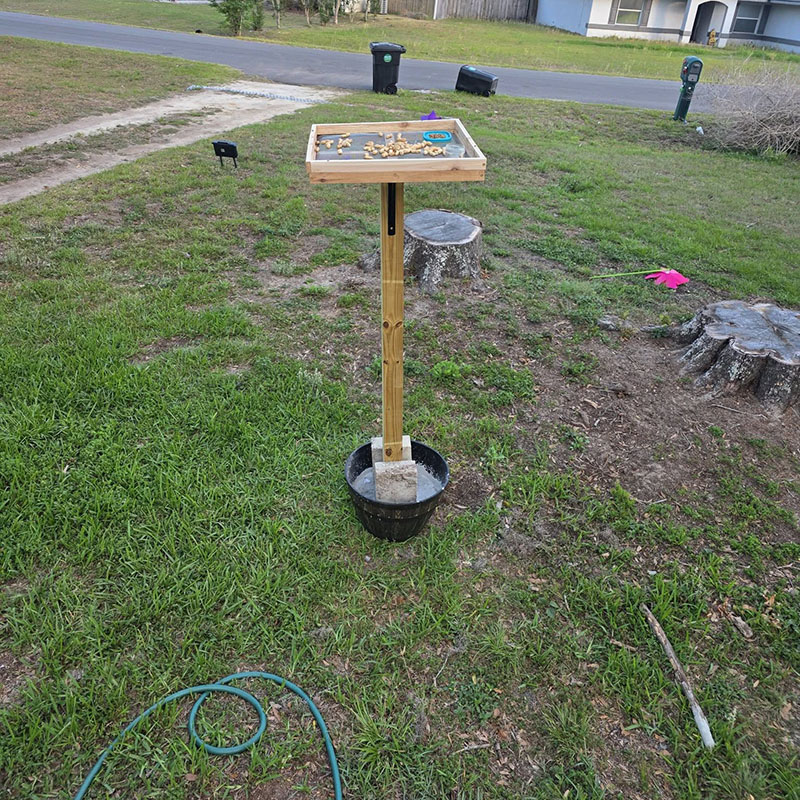
- Place your 4″x4″x8ft pole inside the planter vertically. Use rocks, concrete blocks, bricks, cinder blocks, etc. to hold the pole up. Alternatively, you can set up braces using scrap pieces of lumber at an angle on the ground. Optional, but at this point you can use a level to check that everything is level before pouring the concrete.
- If you are using rocks or bricks to hold the pole, you should have enough weight to add only one 50-lb bag of concrete. We get some strong storms here, and closer to 100 lbs would make it safer since it is top-heavy. For example, the two cinder blocks I used are around 56 lbs, plus the concrete puts me over 100 lbs. *If you are not using anything heavy to stabilize the pole, I’d recommend using two 50-lb bags of quick-drying concrete. If you’re in an area that never has strong winds, you can probably worry about this less. Follow the directions on the bag to set up and cure the concrete.
- While the concrete is curing, you can build your tray. It is a simple 24″ square built with cedar wood. Cut two 22.5″ pieces from the 1″x2″x8′ cedar board. Create a half lap joint and put the two pieces together in an X or plus sign + pattern. Set them aside.
- Create your tray frame by cutting two 24″ pieces and two 22.5″ pieces from the 1″4″x8′ board. Secure them together using the 2″ screws.
- Measure your hardware cloth against the frame or cut a 24×24″ square out. Use gloves for this part as hardware cloth can be very sharp.
- Place your tray on the ground and the hardware cloth square over the bottom. Grab your center support and press it down over the hardware cloth, pushing it in so it bends the hardware cloth with it. You may need to use a rubber hammer or something similar to force it down into the frame. Once it is in the wood frame, secure each side of the support with a 2″ screw from the outside of the frame. Use the staple gun to secure the hardware cloth to the wood along the bottom of the frame and the bottom of the supports. By “sandwiching” our hardware cloth in the wood, we are protecting the crows and any other critters from the sharp edges.
- You will likely need a ladder for this part. Move your completed tray to the top of the pole once the concrete has completely cured (see the instructions on the bag). Use several 2″ screws to secure the center supports to the top pole.
- Place the shelf brackets so the bottom is against the pole and the top aligns with one of the bottom supports of the tray. Use a 2″ screw to secure the bottom bracket to the pole and a 3/4″ screw for the top bracket into the tray support. Repeat this process with the second shelf bracket on the opposite side.
- Put a drill bit on your drill and drill several holes along the outside of the planter, just above the concrete line. Make sure you don’t try to drill into the concrete! I placed a hole every 3-4″ around.
- Fill the planter with potting soil. I used Miracle-Gro Potting Soil. Add pollinator-friendly plants (this differs by region) or seeds.
Notes and Lessons Learned
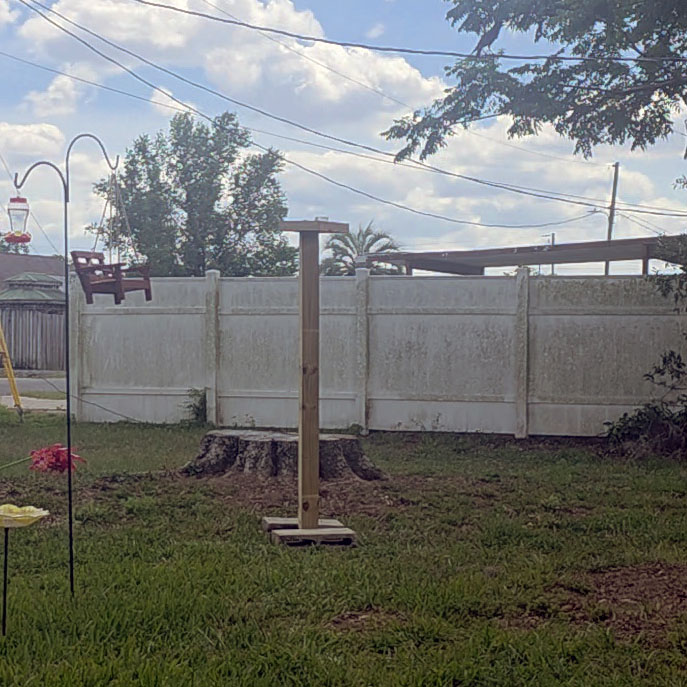
I actually went through several trials and errors when it came to building this. I first put the main pole in the ground. This isn’t a terrible idea, but Florida’s ground is sandy, and unless I added concrete or dug really, really deep, it was going to keep leaning when I put it in. If I added concrete, I feared I would never be able to get it out or move it if needed. I decided then that I would put the main pole into a large flower pot. It needed to be tall enough to hold enough concrete for the pole but also wide enough to support multiple crows flying into it and strong winds without tipping over or becoming unstable. It also needed to be affordable and something I could drill holes into.
That’s a lot of stipulations for a flower pot, but I found the perfect one at Walmart. To be fair, it could have been a little wider, but this is the best option I found for my budget. If you have multiple people or more materials, the next part will be easier. In order to get the pole as level as possible in the concrete, you will need to use a level (or eye it) and then stabilize it somehow. The ideal way would probably be to have someone help hold it or set up multiple pieces of wood around it at an angle to hold it steady. However, it’s just me, and I wasn’t making another trip to the hardware store. So, I used two cinder blocks because it’s what I had. Ideally, two smaller concrete pieces, maybe bricks, that would be buried by the concrete would be used. I knew I was going to plant flowers around the base, so I was hopeful that the ugly cinder blocks sticking out of it would be covered up.
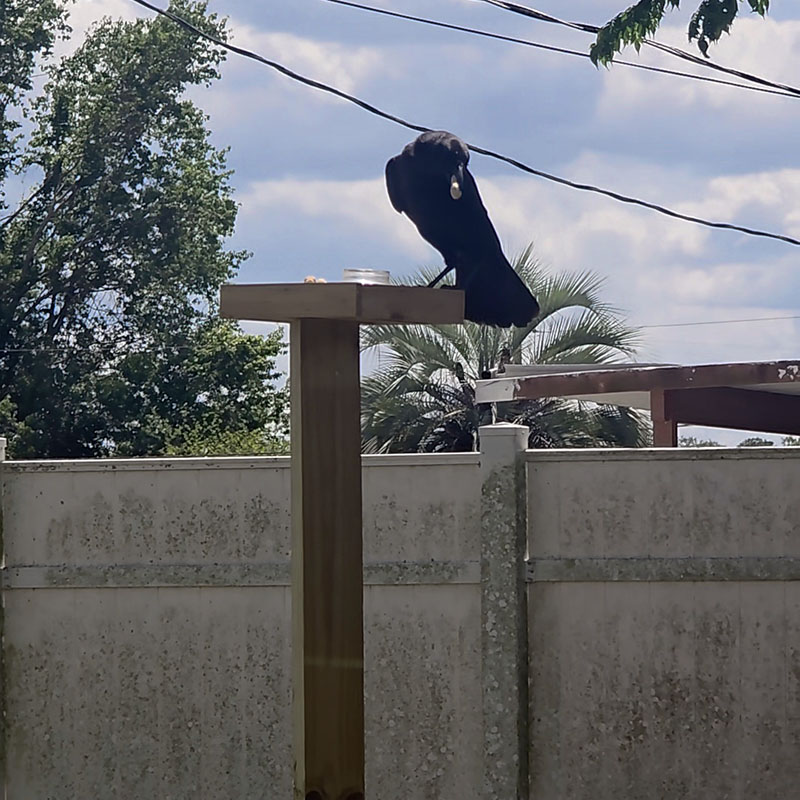
Once I got the concrete poured and it dried completely, I drilled several drainage holes around the perimeter of the flower pot just above the concrete line. Then I placed the store-bought bird feeding tray on top. It was actually a nice little tray even if it looked a bit ridiculous on top of my large tower. It wasn’t until I saw the first crow on it that I realized how small it was and how large crows actually are. There were at times three crows waiting on a nearby powerline to “take their turn.” It was then that I realized I needed a much larger tray. It was out of my budget to buy one, so I made one myself. For this, I used cedar wood. Cedar is the gold standard for outdoor projects in Florida because it is naturally rot-resistant and handles the humidity and rain without warping as much as pine would. Because cedar is a soft wood, make sure to pre-drill your holes to prevent cracking.
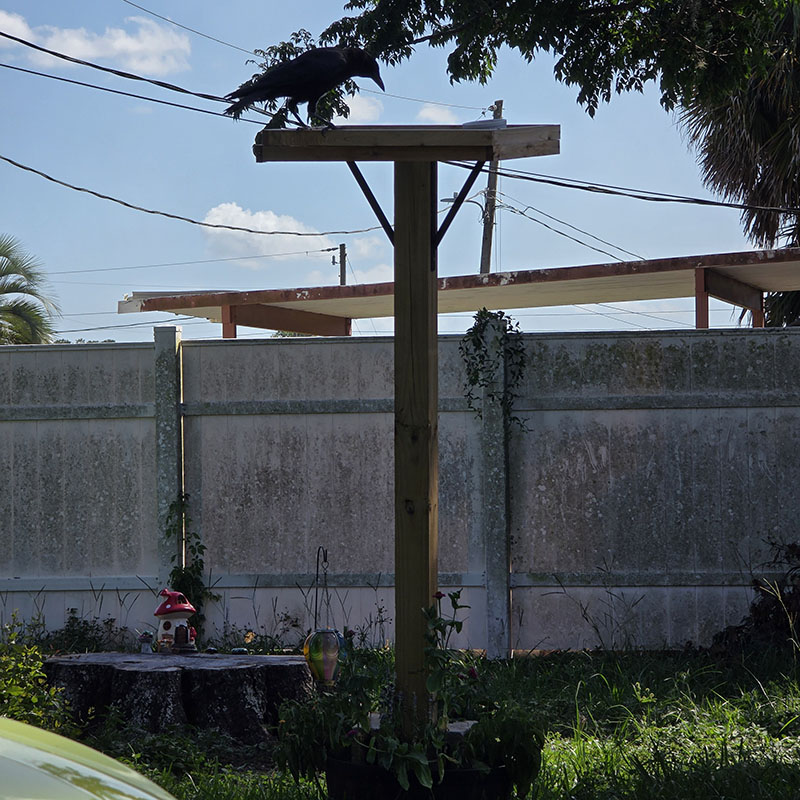
I thought a 1″x2″ would work well, and while it did for the half lap joint in the center of the tray, it did not work so well for the edges. Once I put everything together, I realized between the hardware cloth and center supports, the 2″ was 75% taken up and there wasn’t much room left for the crow’s claws to grip. In retrospect, I would have bought one 1″x2″x8′ board for the center support and one 1″x4″x8′ board for the outside square structure. Instead, I went back to Lowe’s and bought another 1″x2″x8′ board and doubled up what I had already made.
Two-Month Crow Tower Update
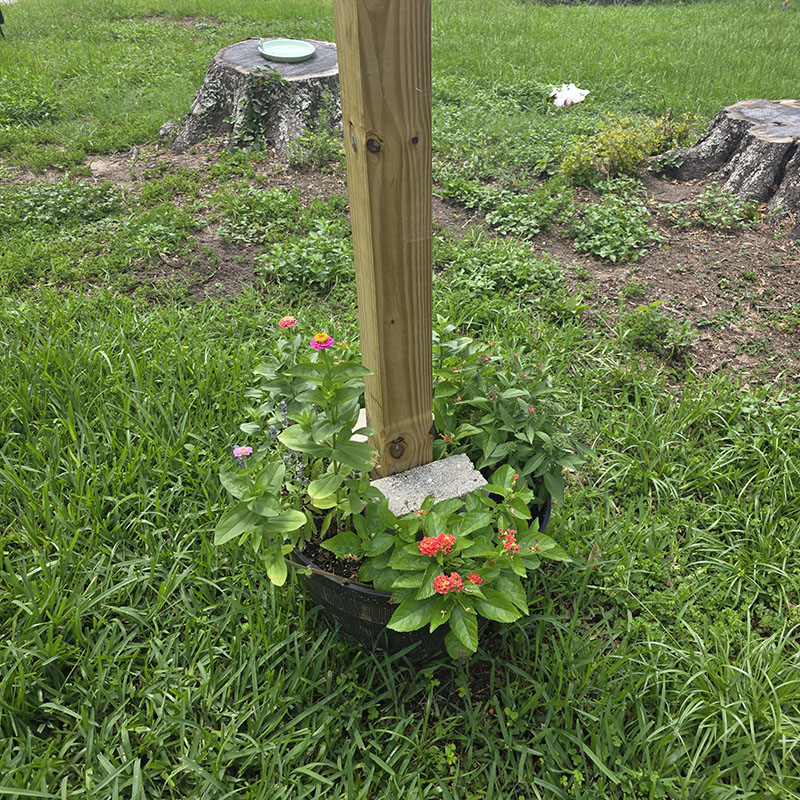
At first I only added salvia and lantana plants. I was given a few zinnia seeds, so I planted those as well, and they have taken off! I might need to move some things around, but right now, I love how everything looks. The cinder blocks are almost completely concealed (from the side).
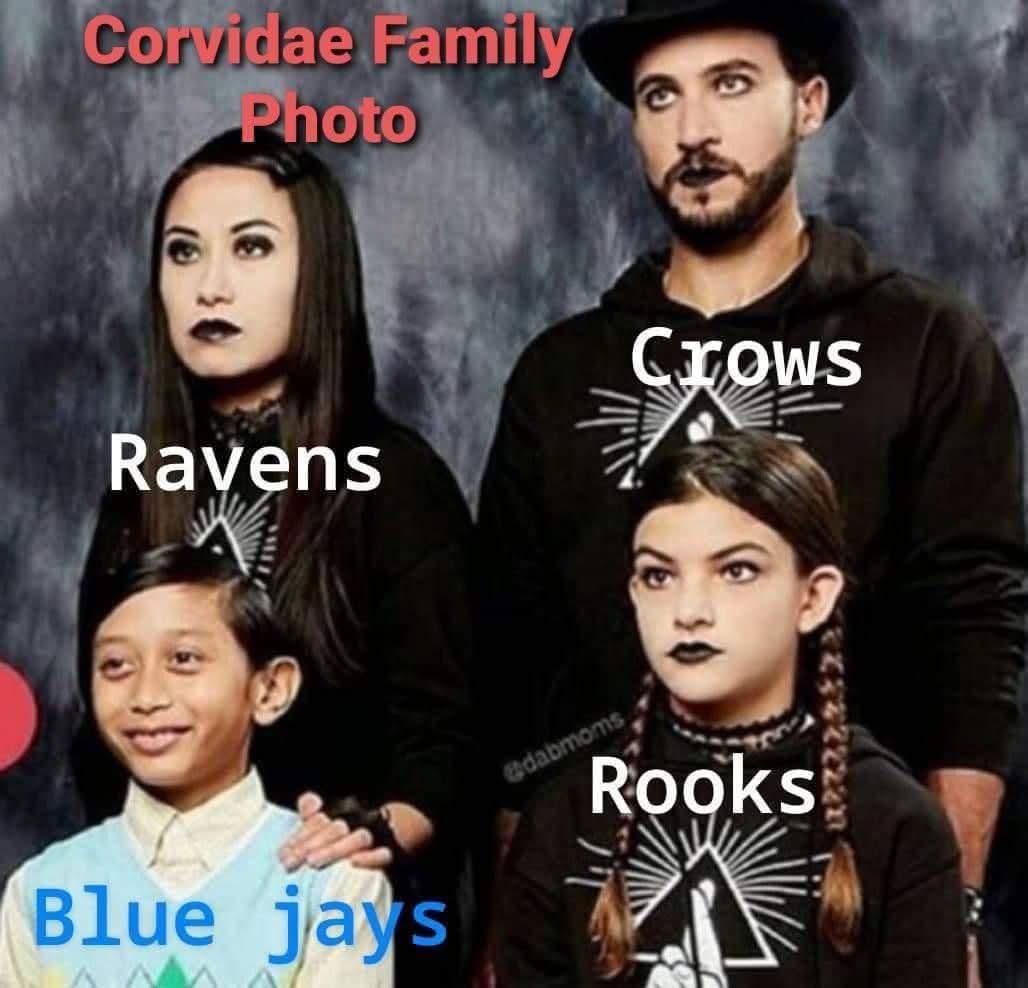
Adding the crow tower also brought around a lot of blue jays! I did not realize they were also corvids. The blue jays and crows fight quite a bit. The crows really hate it when the blue jays make it onto the tower.
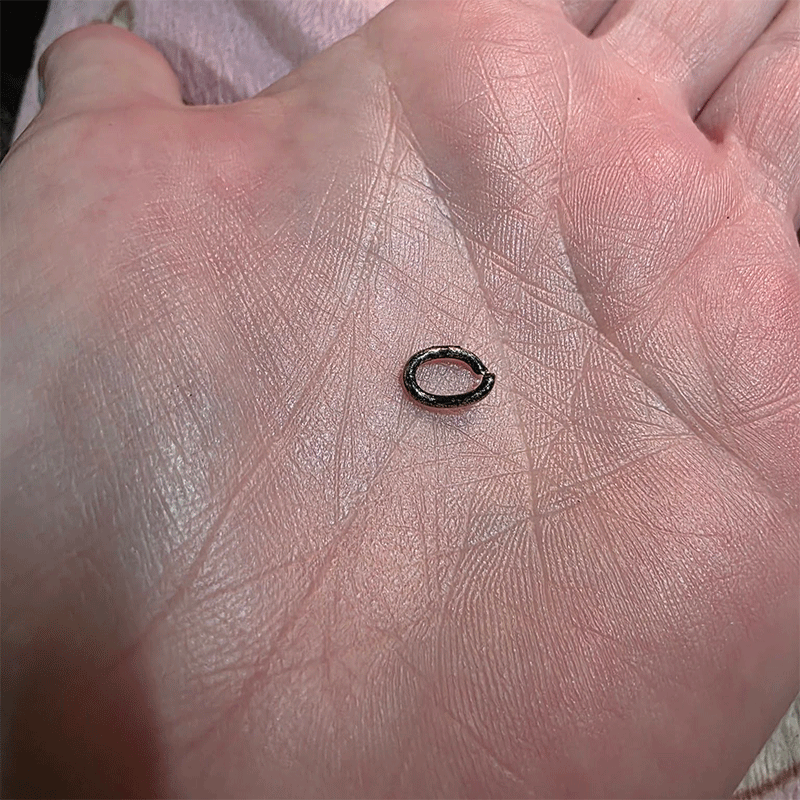
I have found one gift so far. It looks like a black metal link of some sort? I will have to keep an eye out for more.
Crows will not eat cracked corn. So far, all birds I’ve been around love it. I put a small little tray up there for them, and it will stay there for days, so I stopped putting it out. Speaking of what they like to eat…
What to Feed Crows
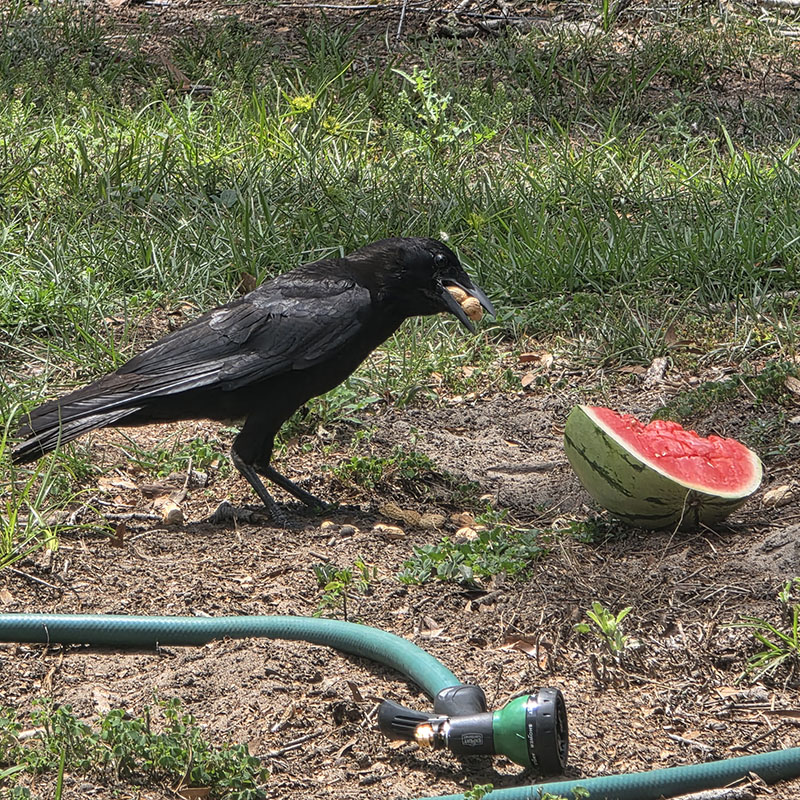
Always offer crows water! Not just because of the temperature outside or the fact they need water, crows often like to dip their food in water before eating it. I went to the thrift store and found a nice small ramekin dish for this. Since the smaller items like cat food can slip through the hardware cloth, I also grabbed a couple of glass/crystal round dishes while I was there. It looks like they may have been coasters in a past life? Small items that will fall through go on the glass dishes, and everything else goes right onto the tray.
The crows I have been feeding adore peanuts (shelled, raw, unsalted). I feel like it is their favorite. They also like high-protein cat food (this is most cat food, but some hairball formulas have higher fiber, which you want to avoid here), boiled eggs (I leave the shell on but crack it open for them), scrambled eggs, dried mealworms, unsalted cashews, unseasoned raw or cooked meat scraps, and small fruits like berries.
AVOID: Seasonings of any kind. Salt, garlic, and onions can be toxic to birds. Highly processed foods. Bread or crackers of any kind. Avocado, chocolate, raw/dried beans, fruit pits, or apple seeds. Rotting food or food with mold.
Fun Facts About Crows
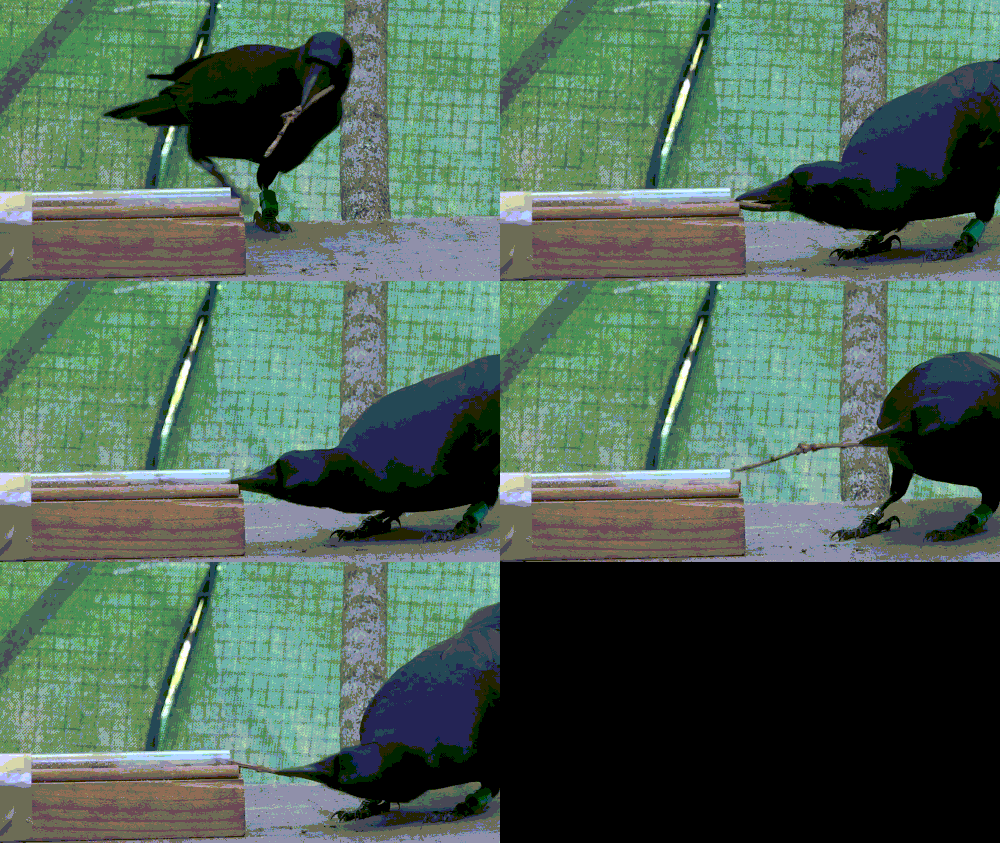
1. They Brainstorm and Fabricate Tools
Crows don’t just happen to use objects they find; they actually modify them to suit a specific purpose. New Caledonian crows, for example, will bend twigs into hooks or fashion stiff leaves into serrated probes to fish insects out of tight crevices. Research shows they can even pass these tool-making traditions down to younger generations.1
2. They Never Forget a Face (or a Grudge)
If you wrong a crow, it remembers. Researchers at the University of Washington wore specific masks while trapping and banding wild crows. Years later, the crows, and even their offspring who hadn’t been born yet, would loudly scold and dive-bomb anyone wearing that exact mask. They communicate “danger targets” to their entire flock.2 This also works the other way around. For instance, when I go out for a walk, the crows will often follow me, flying from powerline to powerline to watch and caw at me from time to time. They desire the peanuts!
3. They Run “Spy Operations” on Each Other
Crows are notorious food-cachers, hiding snacks like nuts or seeds to eat later. Because they are incredibly sneaky, they know their neighbors are sneaky, too. If a crow realizes another crow is watching it cache (hide) food, it will frequently pretend to bury the snack in one spot, fly away with the food still in its beak, and hide it in a secret secondary location.3
4. Their Brain-to-Body Ratio Rivals Primates
Relative to their body size, a crow’s brain-to-body ratio is incredibly similar to that of a chimpanzee. Their forebrain is packed with dense clusters of neurons, giving them advanced cognitive abilities like problem-solving, abstract reasoning, and even a basic understanding of analogy.4
5. They Hold “Funerals”
When a crow dies, the local flock will often gather around the body in large, loud assemblies. While it looks like mourning, scientists believe it’s actually an informational strategy. They are assessing the area for threats to figure out why the crow died so the rest of the flock can avoid making the same mistake.5
6. They Recognize the Concept of Zero
In a 2021 study, researchers found that crows have specific neurons that fire when they perceive a state of “nothingness.” Understanding “zero” as a numerical value, rather than just the absence of something, is an abstract math concept that very few animals can grasp.6
SOURCES:
- Klump, Barbara C. & Rutz, Christian & St Clair, James J. H. & Sugasawa, Shoko & van der Wal, Jessica E. M. (2016, August 1). Tool bending in New Caledonian crows. Royal Society Open Science 3(8). https://royalsocietypublishing.org/rsos/article/3/8/160439/36753/Tool-bending-in-New-Caledonian-crowsTool-bending ↩︎
- Marzluff, John & Walls, Jeff & Cornell, Heather & Withey, John & Craig, David. (2010 March). Lasting Recognition of Threatening People by Wild American Crows. Animal Behaviour 79(3). 699–707. https://www.researchgate.net/publication/223261147_Lasting_Recognition_of_Threatening_People_by_Wild_American_Crows ↩︎
- Clayton, N. S. & Dally, J. M. & Emery, N. J. (2007). Social cognition by food-caching corvids. The western scrub-jay as a natural psychologist. Philosophical Transactions of the Royal Society of London. Series B, Biological sciences, 362(1480), 507–522. https://pubmed.ncbi.nlm.nih.gov/17309867/ ↩︎
- Herculano-Houzel S. (2009). The human brain in numbers: a linearly scaled-up primate brain. Frontiers in Human Neuroscience 3(31). https://pmc.ncbi.nlm.nih.gov/articles/PMC2776484/ ↩︎
- UW Undergraduate Research Symposium. The Crow. University of Washington. https://www.washington.edu/urs/crow/ ↩︎
- Ditz, Helen M. & Kirschhock, Maximilian E., Nieder, Andreas.(2021, June 2).Behavioral and Neuronal Representation of Numerosity Zero in the Crow. Journal of Neuroscience 41(22). 4889-4896. https://www.jneurosci.org/content/41/22/4889 ↩︎

Kat is a stinky little goblin who lives in the swamps of Florida. It is so hot here. Please send ice cream and tater tots.